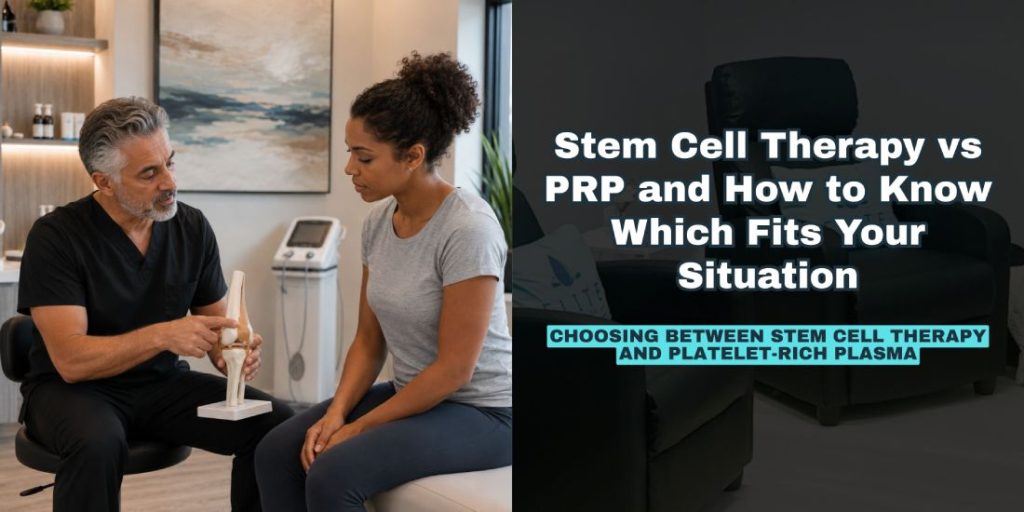
“My doctor mentioned both stem cell therapy and PRP for my knee, almost in the same breath, like they're interchangeable. I don't actually understand what separates them or why someone would choose one over the other. Before I go back for a follow-up, I want to understand stem cell therapy vs PRP well enough to ask the right questions.”
Stem cell therapy and PRP are both regenerative approaches, but they work through different mechanisms and use different source material: PRP concentrates platelets and growth factors from your own blood, while stem cell therapy uses actual stem cells, most commonly sourced from fat tissue or bone marrow, to support tissue repair. Neither is universally better than the other, and which one makes sense depends on the specific condition, its severity, and what a qualified provider determines after an actual evaluation.
The confusion is understandable since both treatments get grouped together under “regenerative medicine” and are often discussed for similar conditions, joint pain, tendon issues, and orthopedic concerns in particular. But the source material, the mechanism, and the evidence behind each option differ meaningfully, which is worth understanding before any decision gets made.
Key Takeaways
PRP uses your own blood, stem cell therapy uses stem cells.
PRP concentrates platelets and growth factors from a blood draw, while stem cell therapy typically sources cells from fat tissue or bone marrow.
The mechanisms are related but distinct.
PRP delivers a concentrated dose of growth factors to support healing, while stem cell therapy introduces cells capable of differentiating and supporting broader tissue regeneration.
Evidence and regulatory status differ between the two.
PRP has a somewhat more established track record in certain orthopedic applications, while stem cell therapy for many uses remains more investigational.
Cost typically differs as well.
Stem cell therapy is generally more expensive than PRP, partly reflecting the more involved collection and processing process.
Neither treatment works the same for everyone.
Individual response, condition severity, and overall health all affect outcomes for both options.
A qualified provider evaluation is essential before choosing either.
This comparison provides general information, not a recommendation for your specific situation.
At Elite IV Hydration, this comparison comes up often, and the honest answer always starts with the specific situation rather than a blanket recommendation for one over the other. Here’s how they actually differ.
What’s the Difference Between Stem Cell Therapy and PRP?
The core difference comes down to source material and mechanism. PRP, or platelet-rich plasma, is created by drawing a small amount of blood, spinning it in a centrifuge to concentrate the platelets, and then injecting that concentrated plasma into the affected area. Platelets carry growth factors that support the body’s natural healing response.
Stem cell therapy works differently. Rather than concentrating existing blood components, it introduces stem cells, typically harvested from the patient’s own fat tissue or bone marrow, which have the capacity to differentiate into different cell types and support more extensive tissue repair. Reviewing regenerative therapy for joint pain covers this distinction in more detail for anyone weighing both options for a joint-related concern specifically.
Key Differences Between Stem Cell Therapy and PRP
Understanding these distinctions helps frame a more informed conversation with a provider.
1. Source Material
PRP comes from a patient’s own blood, drawn and processed the same day. Stem cell therapy sources cells from fat tissue or bone marrow, which typically involves a more involved collection process than a simple blood draw.
2. Mechanism of Action
PRP works primarily by delivering a concentrated dose of growth factors to accelerate the body’s existing healing response. Stem cell therapy introduces cells with the potential to differentiate and contribute more broadly to tissue regeneration, a mechanistically different and generally more complex process.
3. Typical Conditions Considered
Both are discussed for orthopedic conditions like joint pain and tendon injuries, though PRP is more commonly considered first for milder or earlier-stage issues, while stem cell therapy often comes up for more significant degeneration, such as stem cell therapy for cartilage degeneration.
4. Evidence and Regulatory Status
PRP has a comparatively more established research base for certain orthopedic applications, though evidence still varies by condition. Stem cell therapy, particularly for many of its current applications, often falls into more investigational or off-label territory depending on the specific use and cell source.
5. Cost and Procedure Complexity
Stem cell therapy is generally more expensive than PRP, reflecting the more involved collection and processing required. PRP’s simpler blood-draw-based process typically makes it the less costly of the two options.
The Comparison at a Glance
Factor | PRP | Stem Cell Therapy |
Source material | Patient’s own blood | Fat tissue or bone marrow |
Mechanism | Concentrated growth factors | Cells capable of differentiation |
Typical use | Milder to moderate joint or tendon issues | More significant degeneration or injury |
Evidence level | More established for certain applications | Often more investigational |
Relative cost | Lower | Higher |
Procedure complexity | Simpler, same-day blood draw | More involved collection process |
Situations Where PRP Is Often Considered First
A few patterns tend to point toward PRP as an earlier or more accessible option.
- Earlier-stage joint or tendon issues without significant structural damage
- Situations where a lower-cost regenerative option is preferred as a starting point
- Conditions with a more established evidence base specifically for PRP
- Patients who want a simpler, same-day procedure without more involved tissue collection
- Cases where a provider recommends trying PRP before considering more involved options like stem cell therapy for knee pain
When Might Stem Cell Therapy Be the Better Fit?
Stem cell therapy tends to come up more often for conditions involving more significant tissue degeneration or when PRP hasn’t provided sufficient improvement. This is particularly true for conditions like stem cell therapy for osteoarthritis, where more advanced joint changes may call for an approach with a broader regenerative mechanism.
That said, this isn’t a strict hierarchy where stem cell therapy is always the “stronger” next step after PRP. The right choice depends on the specific condition, individual health factors, and what a qualified provider determines through direct evaluation, not a general rule that applies to every situation the same way.
How to Decide Which Option Makes Sense for You
A few steps typically help clarify which option, if either, fits a specific situation.
- Get a thorough evaluation of the specific condition, including its severity and how long it’s been present, from a qualified provider.
- Ask directly about the evidence and regulatory status for the specific application being considered, for either treatment.
- Discuss what’s already been tried, since prior treatment history often factors into which option makes more sense next.
- Understand realistic expectations for both cost and likely outcome before committing to either option, particularly for stem cell therapy for chronic pain and injury recovery where individual response varies considerably.
Frequently Asked Questions
Is PRP or stem cell therapy more effective?
Neither is universally more effective, since effectiveness depends heavily on the specific condition, its severity, and individual factors. PRP has more established evidence for certain earlier-stage applications, while stem cell therapy is often considered for more significant degeneration, but a qualified provider evaluation is the only reliable way to determine which fits a specific situation.
Can PRP and stem cell therapy be used together?
Some providers do combine these approaches depending on the condition and treatment plan, though this decision should be made based on a specific evaluation rather than as a general recommendation. Discussing this possibility directly with a qualified provider is the appropriate next step.
Is stem cell therapy FDA approved?
Many stem cell therapy applications, including several orthopedic and anti-aging uses, are considered off-label or investigational rather than specifically FDA-approved for that use. This varies by application, which is why understanding the regulatory status for your specific situation matters before proceeding.
How long do the effects of PRP or stem cell therapy typically last?
This varies considerably by individual, condition, and severity for both treatments. Some patients report improvement lasting many months to over a year, while others see more modest or shorter-term results. There’s no universal timeline for either option.
Which option costs less, PRP or stem cell therapy?
PRP is generally less expensive than stem cell therapy, largely due to the simpler blood-draw-based collection process compared to the more involved tissue collection required for stem cell therapy. Exact costs vary by provider and specific treatment plan.
Neither Option Is Automatically the Right Choice
Stem cell therapy vs PRP isn’t a competition with one clear winner, they’re different tools suited to different situations. Understanding the mechanism, evidence, and typical use for each makes it possible to have a genuinely informed conversation with a provider, rather than choosing based on which term sounds more advanced.
Talk Through Your Options With Elite IV Hydration
Figuring out whether PRP, stem cell therapy, or neither fits your specific situation starts with an honest evaluation, not a one-size-fits-all recommendation. Elite IV Hydration, founded by registered nurse Jana Marra, offers consultations to help you understand your options clearly at locations in Sarasota and Lakewood Ranch. Call (941) 388-8723 or schedule a consultation to discuss what actually fits your situation.